Horoearth
I. Falling into the Negative Curvature
The survey vessel Endeavor passed through the throat of the Alcubierre wormhole with a smoothness that was almost unnerving. As predicted by general relativity simulations, the crew observed the classic gravitational lensing effect on the monitors: the starlight behind them was stretched into a brilliant Einstein ring, and spacetime, under the intense gravitational field, displayed a saddle-shaped distortion of Gaussian negative curvature.
However, when the thrusters shut down and the ship completely cleared the wormhole’s exit, Chief Navigator Helen’s fingers froze on the control panel.
She stared at the curvature readings on the panoramic bridge display, which had failed to return to normal, and for the first time began to doubt her own judgment. According to Article 17 of the United Deep Space Exploration Protocol, spatial curvature calibration must be conducted immediately after wormhole transit. Yet the oscillating negative curvature reading on the calibrator had persisted for forty-seven seconds.
“Residual metric fluctuations from the wormhole?” Captain Elena frowned. At that moment, stress alarms from the ship’s hull began to sound.
“No, Captain. The current curvature is even greater than what we experienced inside the wormhole.” The voice of physicist Dr. Zhang Mingyuan came from the science station, grave and steady. “This isn’t a fluctuation. It’s the property of the background space itself. We have not returned to flat Euclidean space.”
Helen pulled up historical data for comparison, her voice tightening. “The last time we passed through the M87 wormhole, the negative curvature signal decayed to zero after fifteen seconds. But now—“
Her words cut off abruptly. Researcher David brought up the environmental parameters. On the screen appeared a cold mathematical fact: they had entered a hyperbolic space of constant negative curvature, with an equivalent spatial curvature radius of only two hundred meters. On astronomical scales, this was an extremely curved space. The ship was already experiencing significant curvature tidal forces.
“Does that mean we’ve passed through the wormhole into some kind of miniature spherical universe?” biologist Elisa asked. The profound terminology had left her dizzy, but she was still trying to understand.
“No. A spherical universe has positive curvature. The universe we’re in now has negative curvature. It’s equivalent to saying that the radius of this ‘sphere’ is imaginary. In fact, negatively curved space is infinite— and in a certain sense, even more vast than flat space,” Zhang Mingyuan explained.
On the main screen, where empty deep space should have appeared, a tiny, regularly shaped point of light emerged. “Unidentified celestial body dead ahead!” Helen’s warning came almost instinctively.
Before anyone could recover from the shock of their collapsing physical intuitions, the radar alarm pierced the silence. On the display, the tiny dark red point representing the distant object expanded at an utterly counterintuitive speed within ten seconds, instantly filling the entire field of view.
“Collision warning! It’s too fast!”
Captain Elena gave a decisive order: “Full reverse pulse! Jettison the main fuel tank!”
The ship shook violently. Under the metric of negatively curved space, the antimatter engines emitted an unexpectedly high-frequency resonance. After a blinding flash of light, the vessel completed its deceleration in the instant before impact and, captured by gravity, slipped into orbit around the massive body.
It was not that the celestial body was approaching too quickly. Two seconds later, Helen suddenly understood—it was the geometry of space itself that had deceived their perception of distance. In hyperbolic geometry, an object’s apparent size in the field of view decays exponentially with distance, rather than by the inverse-square law. This meant that any approaching object would appear abruptly within an extremely short span of time.
What they had seen as “far beyond the horizon” had in fact been right before their eyes.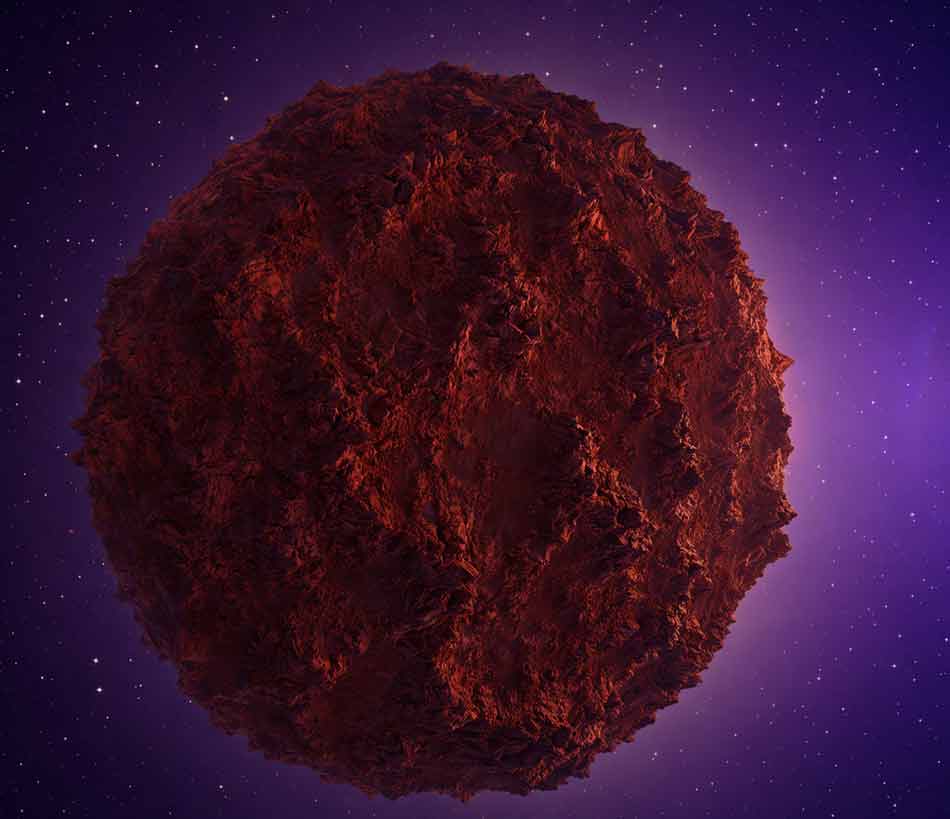
“Damage report.” Elena’s voice was exceptionally calm, though her knuckles were white from gripping the railing.
“The main propulsion array is severely damaged,” Chief Engineer Karlovich reported from the lower deck, his breathing strained. “The overload from the emergency maneuver tore the primary fuel lines apart. We still have attitude control thrusters and are calibrating the orbit at full capacity to ensure stable flight, but to escape this gravitational well… that would require a miracle.”
“Then assume a miracle is on its way.” Elena turned to Dr. Zhang. “First, let’s determine what we’re orbiting.”
Measurements continued for seventy-two hours.
The first batch of data overturned every known model of celestial bodies. The laser rangefinder returned a different radius estimate with each measurement: from one hundred kilometers to ten thousand kilometers, the values jumping randomly.
“It’s not instrument failure.” Zhang Mingyuan displayed a mathematical model during the science briefing. “This object may not possess a radius in the traditional sense—or rather, it may be infinite. It is a horosphere—a special surface in hyperbolic geometry.”
“A sphere with infinite radius?” Elisa frowned. “That defies intuition.”
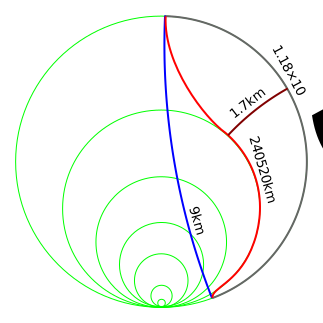
“It does not defy mathematics.” Zhang projected the Poincaré disk model. “This disk is the projection of two-dimensional hyperbolic space. Don’t be misled by its confinement within this small circle. The projection compresses regions closer to the boundary more and more. In actual hyperbolic space, the boundary lie at infinity.”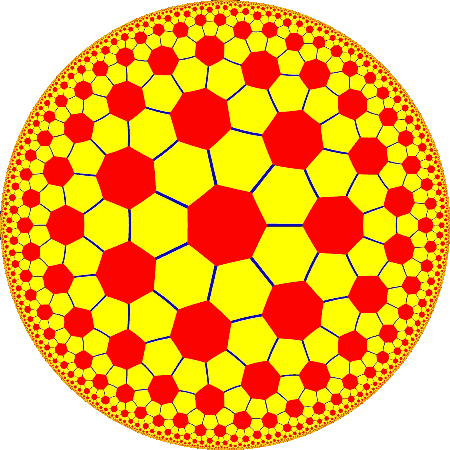
“In hyperbolic space, a horocycle still appears to a Euclidean observer as an ordinary finite circle tangent to the boundary of the disk. But within hyperbolic space, its radius is infinite, because its center lies on the boundary of the Poincaré disk model—that unreachable infinity. What we are orbiting now is a three-dimensional analogue: a horosphere in hyperbolic space H³. Measured from the inside, both its volume and surface area are infinite.”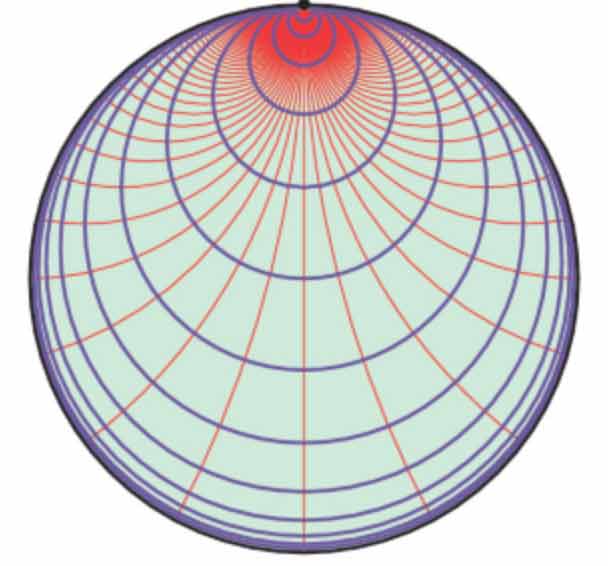
He then showed further calculations. “You’re right, though. This not only defies intuition—it defies physics. General relativity predicts that in a normally negatively curved spacetime, both space and time are curved. In such a space, a rigid body of infinite size would endure infinite tidal forces. This planet should have collapsed into a black hole long ago. It cannot exist. However, the anomaly is not the planet—it’s the spacetime here. Observational data show that the temporal direction around us is nearly flat; only the spatial directions are extremely curved, with an effective curvature radius of merely 200 meters. This implies that in the Einstein field equations there must exist some absurdly large superluminal energy-flux term—an utter nonsense.”
“You’re saying relativity fails here?” Helen asked, perplexed.
“General relativity fails, but special relativity still holds. We still need Lorentz transformations to correct the signals the ship receives. Look—this is the function describing how gravitational field strength varies with altitude.” A steep exponential curve appeared on the screen. “Gravity decays exponentially with distance, not by the usual inverse-square law. That’s a defining feature of a horosphere in hyperbolic space.”
“And our orbit…?” Elena pointed to the orbital simulation.
“Not an ellipse, but a horocycle—an infinite-radius circle. We are not periodically orbiting the planet; we are continually heading toward new distances. The good news is that the orbit appears stable for now. The bad news…” Zhang Mingyuan paused. “Although gravity weakens rapidly, if we attempt to escape using only the attitude control thrusters, we would require a hundred times more energy than we have in reserve. We don’t have enough fuel. And the lack of periodicity means that the farther we glide now, the farther we drift from the direction of home.”
The meeting fell into silence. The ship drifted like a fallen leaf above this infinite celestial body—until structural stress alarms sounded again.
The ship’s lower structure, already weakened by the earlier explosion and intensified tidal forces caused by the negative curvature geometry, had reached the limits of stress fatigue. With a dull metallic tearing sound, the life support systems began to issue warnings. For survival, they had to make an emergency landing.
Elena selected a relatively flat region as the landing site. The vessel touched down amid violent shaking. The landing gear was completely destroyed, but the hull structure remained largely intact. When they stepped out of the ship, they felt gravity similar to that of Earth: the gravitational acceleration at the landing altitude was approximately 7.2 m/s², slightly lighter than Earth’s. The atmospheric composition was unexpectedly suitable for human respiration, though the sky displayed a peculiar pale violet hue—a special effect produced by the combination of Rayleigh scattering in the planet’s atmosphere and geometric distortion from hyperbolic space.
The scene before them was desolate yet magnificent: the ground was covered in dark red rock, and mountain ranges undulated in the distance. There was only a faint, constant background starlight; the entire planet lay shrouded in night. Because of the negative curvature, the horizon exhibited an exaggerated arc—they could stand on the ground and directly perceive that the planet beneath their feet was spherical. The curvature of the horizon was strikingly obvious, like viewing Earth’s arc from the International Space Station.
“Repairing the thrusters requires three things,” Karlovich reported eight hours after landing. “An iridium-alloy catalyst, superconducting coils, and high-purity helium-3. We have spares for the first two, but our helium-3 reserves leaked out during the impact.”
II. First Acquaintance
“Is there helium-3 on this planet?” Elena asked.
Researcher David pulled up the spectral analysis. “There’s a strong signal. But the nearest enriched deposit is… at the planet’s core?” The probe readings indicated it wasn’t far—only about ten kilometers.
“That’s not far,” Elena said. “Our drilling equipment can handle up to five hundred kilometers of ordinary high-density rock. The surface rocks of this planet look very porous. Forget ten kilometers—we could manage a thousand.”
The drilling rig began its work. “Current set speed: 0.5 meters per second.” Engineer Karlovich remotely operated the drill from the ship’s control room as it advanced slowly downward. It had been running for one minute. On the surface, a bottomless vertical shaft was left behind.
At some point, a faint glow appeared in one section of the sky, gradually brightening. The sun did not rise from the horizon; instead, it slowly emerged from somewhere in the sky itself—at first like a star, then steadily increasing in brilliance.
“Look! This planet has a sun!” Helen shouted.
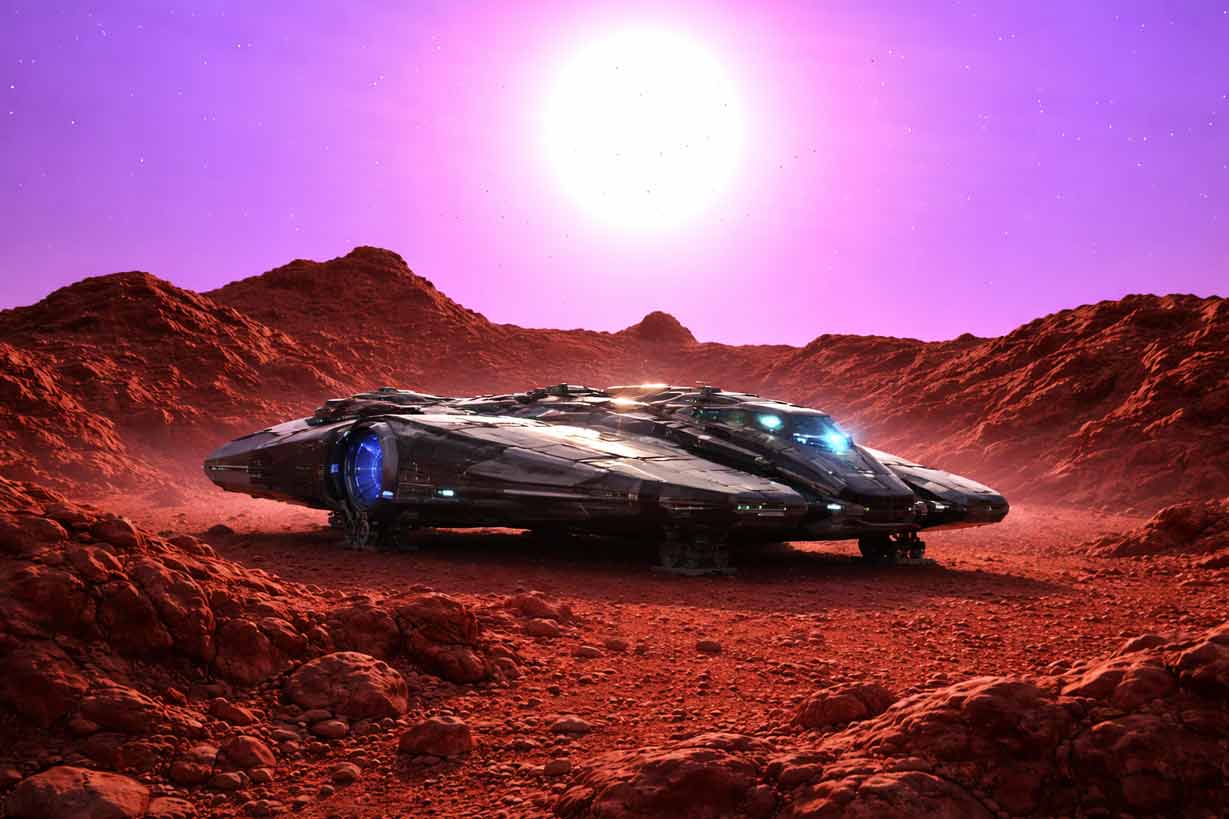
The sun’s radiance intensified the violet hue of the sky, bathing the entire landscape in that color. The distant red mountains were tinted purple, and for the first time they could clearly see this bizarre world. They noticed that the sun was moving at a perceptible but extremely slow rate across the sky. Then the sky began to dim again. The sun did not set; it simply grew smaller and smaller in the sky, much like when it had first appeared, until it shrank to a star-like point and vanished. Darkness reclaimed the land once more.
“Feels like we’ve hit a soft, fluffy hard rock down there,” Karlovich said, studying the drill’s returned data.
“A soft hard rock? Is that even a thing?” Elena looked at the control screen.
“The drill is at the upper boundary of this layer. It feels like a transitional region—very soft at first, but gradually getting harder.”
Twenty seconds later, the drill’s pressure readings finally stabilized. “We’ve finally entered the rock interior,” Karlovich began—but before he could finish, the pressure readings started rising again, slowly at first, then with increasing acceleration.
“I suspect this isn’t rock or any conventional geological structure. It’s hyperbolic geometry at work,” Zhang Mingyuan said calmly. “Based on my estimation, the pressure on the drill bit will increase exponentially. If we make it to one kilometer, we’ll be lucky.”
They all observed that the pressure growth trend ahead of the drill was indeed accelerating. No one knew how long the machine could endure. At last, the drill stopped at 850 meters. The immense pressure triggered its automatic shutdown protection system; otherwise, the bit would have become permanently lodged in the rock layer. They understood that the equipment had already reached its pressure limit ahead of schedule. With no alternative, they recalled it. Under conventional understanding, the overlying rock pressure here should not have been so terrifying—but the geometric properties of a horosphere in hyperbolic space meant that the mass of rock above increased exponentially, and so did the pressure.
“It seems we’ll have to live here for now. The ship’s life-support system can operate for one year at most.” Next, they would have to explore the planet’s resources and ideally find a continuous supply—most crucially, energy. Otherwise, in a year’s time, they would simply be waiting to die.
“What are the components of the rock we drilled up?” Elena pressed the geologist standing beside Karlovich.
“It’s a mineral with extremely low density but extraordinarily high hardness. Quite unbelievable. This red material is mainly composed of carbon, nitrogen, and boron, but I don’t yet understand how its density can be driven so low. We’ll need diffraction analysis,” the geologist replied. “The several hundred meters we drilled through were almost entirely this material, with only trace impurities in some areas.”
Karlovich added, “But it’s of no use to our energy systems. For now, the best option is to find materials locally to expand the solar array and delay the depletion of our energy reserves.”
Elena summoned Karlovich to the terrain-scanning display in the control room. “It looks like barren red rock everywhere around us. Except on those two sides… See that mountain ahead? The terrain scanner shows what look like forest-like spikes on the other side. The mountain is a bit high, but the top is a plateau—easy to traverse. I suggest taking a team to investigate.” Because the planet was a horosphere, they could see only the nearby mountain slopes; the plateau curved downward with the celestial dome beyond the horizon. Without the terrain scanner, they would have seen nothing beyond the immediate rise.
“There’s also a roughly circular depression to the left. Its color differs from the surrounding red rock—looks like a meteor crater. I’ll take a team to analyze the rock composition there,” Karlovich said. “I can send robots first to scout the depression. No need to risk people immediately. But that mountain—robots won’t be able to climb it. You’ll have to lead the ascent yourselves.”
“To the right of the mountain there’s a fragmented canyon. It’s winding and rough, but I recommend taking that route instead of climbing onto the plateau,” Zhang Mingyuan said.
“Why go that way? The canyon looks dangerous. We need to prioritize safety,” Elena replied.
“Because distances behave deceptively in hyperbolic space. Crossing the mountain may take several times longer than it appears,” Zhang explained. “The good news is that a horosphere planet in hyperbolic space theoretically has a Euclidean metric on its surface—that is, every point can be expressed in latitude and longitude, and those coordinates correspond to actual surface distances anywhere. Navigating through the canyon won’t be difficult.”
“I don’t care. This is exploratory anyway. Who knows—maybe there’s something valuable up on the mountain. We’ll just bring extra supplies. Technically, the canyon lies to the south. Look, this planet has a stable geomagnetic field. We won’t get lost!” Elena remained as confident as ever. They originally estimated it would take just over an hour on foot to reach the “forest” on the far side, while Zhang estimated more than two hours. After packing sufficient supplies, Elena’s team set off. Meanwhile, Engineer Karlovich and his assistant operated the robot from the ship’s central control, sending it toward the circular crater.
Not long after setting out, Elena’s team felt firsthand the malice of negative curvature. The mountain ahead, which had not appeared very tall before, now seemed to grow larger at an exponential rate. At the same time, when they looked back, the ship—parked not far away—was shrinking rapidly, nearly merging with the surrounding red rock before finally disappearing below the curved horizon due to the curvature of the horosphere planet.
They began climbing. Since the planet’s gravitational acceleration was lower than Earth’s, the ascent—though steep—was manageable. The atmosphere was extremely thin; the pressure readings dropped exponentially. The sensation was strange, like lightly climbing Mount Everest. But Elena’s team were seasoned explorers of terrestrial-like mountain ranges and had brought sufficient oxygen. These conditions posed no real obstacle. Before long, they reached the plateau at the summit. The mountain was not particularly tall—the altimeter showed they had climbed ninety meters above the base. Yet looking back down, the entire “Earth” beneath them seemed much smaller, as though they had moved from low Earth orbit to geosynchronous orbit in their view of Earth.
Meanwhile, Karlovich’s robot, traveling west by southwest, reached the crater’s edge. The detectors confirmed metallic ores at the center, but sampling would require descending into the crater. Terrain scans revealed a gentler breach on the opposite side, so he began guiding the robot along the rim toward that point. He, too, felt the malice of hyperbolic curvature: the seemingly modest circular crater had an astonishingly large circumference. Karlovich estimated it would take nearly an hour to reach the opposite breach.
Zhang Mingyuan was not idle. He was discussing with the astronomer their current position within the broader hyperbolic universe, as well as the nature of the “sun.” For convenience, they referred to the star visible in the sky as the “sun.” They observed that the earlier sun was merely one among countless suns. In fact, while their ship had been gliding along a horocyclic orbit, they had already glimpsed two small suns in the distance—though no one had paid attention at the time. Reviewing the ship’s environmental recordings, they discovered that the trajectories of these suns were nearly geodesics of hyperbolic space—the straightest possible lines. Due to spatial curvature, they skimmed past the horosphere planet at various altitudes before quickly receding toward infinity. “They’re so small! Rather than suns, they’re more like moons—no, even smaller than moons! These suns are like a swarm of fireflies, flying randomly around this infinite planet, taking turns illuminating the sky!”
They continued tracking the stars overhead. Zhang noticed a star near the southern horizon gradually brighten into a sun, then fade again. Suddenly he realized something. “Come—we need to take the instruments to the mountain base immediately. Here, regions only a few hundred meters apart can have completely different skies due to horizon obstruction. Let’s observe whether solar activity might affect Elena’s team.”
They took ten minutes to descend and set up equipment at the mountain’s base. They found that a star on the eastern horizon would brighten into a sun within twenty minutes—and that this sun would pass extremely close, calculations suggesting a periapsis possibly below one kilometer above the surface.
He immediately contacted Elena. “Get down from the mountain! There may be danger! The danger comes from the sun!” Over the communication channel, the astronomer’s voice was urgent. “A sun is flying along a geodesic in hyperbolic space straight toward you. Calculations show its closest approach may be less than one kilometer! You have at most twenty minutes! The atmosphere is thin, with little attenuation—direct radiation and thermal shock—”
Elena instantly grasped the terror behind those brief calculations. Though the sun was very small, at such proximity the solar irradiance would increase exponentially. The concentrated sunlight would sweep across the land like an invisible flamethrower.
“Run! To the canyon! Now!” There was no time for debate. Survival instinct overrode everything. They turned and sprinted toward the fragmented canyon Zhang had previously indicated. The eternal black-violet dome overhead was already turning pale—not the gradient of sunrise, but an ominous, rapidly spreading pallor radiating from an unseen point directly above, as if the sky itself were being heated to incandescence.
Five minutes later, the pallor shifted to a blinding golden white. Instrument readings soared, quickly surpassing the benchmark of Earth’s summer noon sunlight. The heat did not come from a single direction—it seemed to erupt simultaneously from the surrounding air. The visors automatically darkened but could not fully block the searing intensity. Elena glanced at the temperature display on the back of her glove: it had climbed to 55°C and was still rising. The rock surfaces began to shimmer with nearly invisible heat distortion. The thin air emitted a faint, sizzling sound—whether imagination or dust particles radiating under extreme heat was impossible to tell.
They slid, jumped, and scrambled down the steep canyon wall. At last, they squeezed into a narrow rock fissure, temporarily shielding themselves from direct sky exposure. The golden-white light diffused across the rough stone, and the temperature stabilized—but at nearly 90°C. Inside their sealed suits, the circulation systems hummed under heavy load, struggling to dissipate the heat from both their bodies and the environment. They huddled in the shadow of the rock cleft, listening to faint cracking sounds outside as stones fractured under rapid thermal stress, filled with primal fear of the “death sun” overhead.
After an indeterminate time—perhaps only ten minutes—the suffocating brightness began to fade. The temperature’s rise halted, then slowly receded. When instruments indicated that environmental light intensity and temperature had dropped to barely tolerable levels, they cautiously peered out. The sky had returned to its peculiar pale violet hue.
They abandoned the idea of returning to the mountain and instead proceeded along the deep, winding canyon toward their destination. The canyon terrain generally sloped downward, the path more complex than open ground, often requiring climbing or detouring around collapsed boulders. Yet after walking for about half an hour, the accompanying geologist, examining the locator and terrain-matching data, uttered an incredulous murmur: “We… we seem to be almost there. The terrain features ahead match the fuzzy scan of the ‘forest’ edge.” This was twenty minutes faster than even Elena’s most optimistic estimate.
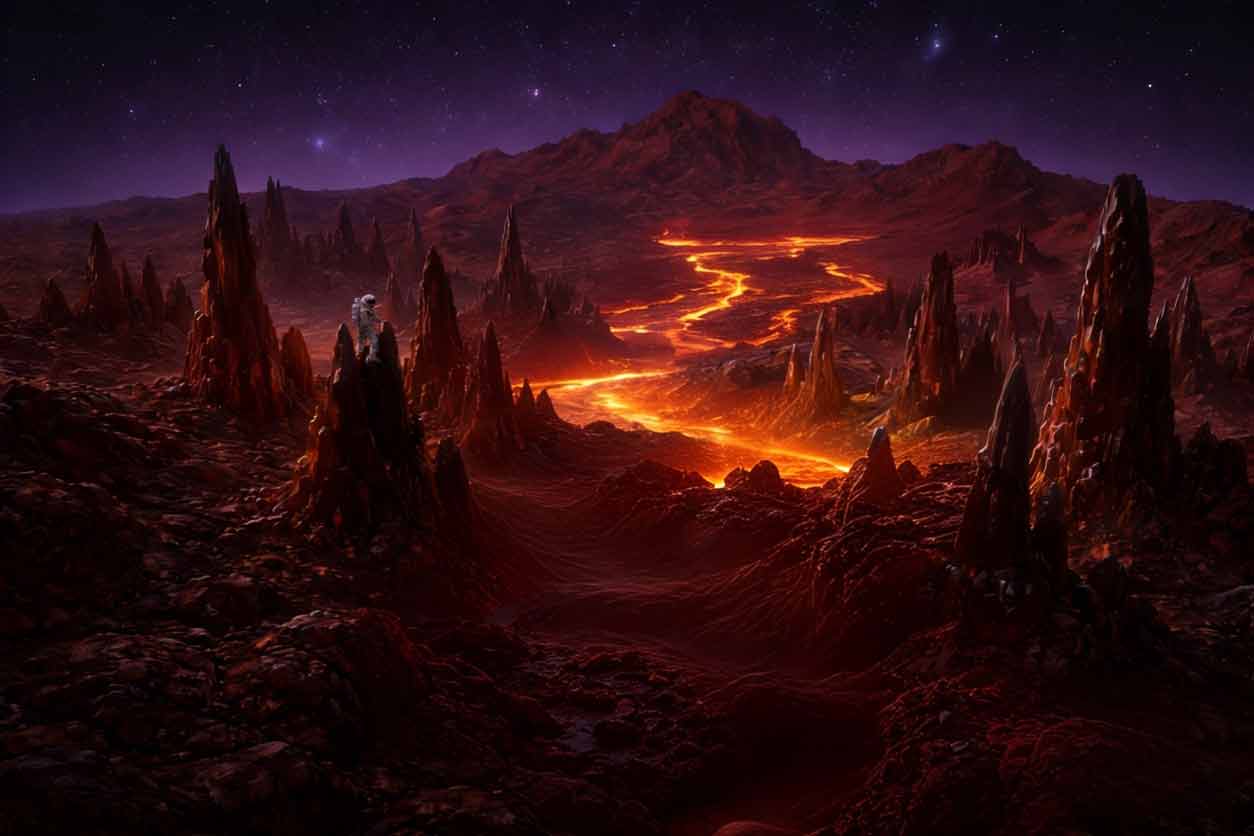
When they finally emerged from the canyon’s end, what appeared before them was not an organic forest, but a breathtaking stone forest. Countless jagged stone pillars, tens of meters tall, thrust upward from the ground. Their material shimmered in dark red, ochre, and obsidian-like glassy textures, gleaming cold and hard under the violet sky.
They climbed atop a relatively low pillar to gain a better vantage point. It was then that they saw the shocking sight: less than one hundred meters into the stone forest, a region where the pillars had vanished, replaced by a slowly flowing river of lava glowing dark red! Along the lava’s edge, the bases of surviving pillars showed clear signs of melting and resolidification, twisted into grotesque forms.
“It was the sun just now,” the geologist said hoarsely. “Its flyby was too close. These pillars are mainly silicates and metal oxides. Their melting points are high—but the temperature just now clearly exceeded them.” Preliminary portable instrument analysis confirmed this. However, in terms of the energy and ship-repair materials they urgently needed, both composition and morphology were useless.
Hope shattered, Elena had no choice but to order a retreat along the original route. They retraced their path through the canyon, their spirits heavier than before.
Upon returning, Zhang Mingyuan showed little surprise. He merely pointed out calmly, “On a horosphere planet, advancing through a deeply incised canyon like that may result in an actual path shorter than our geometric estimate based on a flat surface at the same altitude. The canyon guided us. In a sense, we were walking along a relatively efficient route closer to a geodesic. That’s why I suggested the canyon in the first place—though I hadn’t anticipated the solar hazard. Fortunately, we went down to the mountain base to monitor solar activity. Otherwise, you would have run into serious trouble.”
At the very moment Elena’s team encountered the solar flyby, Engineer Karlovich, who had remained aboard the ship, was fully absorbed in operating the exploration robot. The robot had been traveling along the rim of the enormous meteor crater for quite some time. This location lay one kilometer from the ship and three kilometers from Elena’s team. Due to the geometric properties of hyperbolic space, the crater and the ship’s vicinity were still under night sky conditions, completely unaware of the sun that had nearly incinerated Elena’s group.
At the edge of the robot’s transmitted image, a peculiar reflective mineral deposit on the crater wall briefly caught Karlovich’s attention. He instinctively adjusted the camera to zoom in, and in doing so made a negligible error with the control stick. On the rugged, unstable crater rim terrain, that tiny mistake was magnified. One of the robot’s tracks suddenly slipped, crushing a loose slab of rock. The entire machine lost balance and slid down the nearly 45-degree crater wall.
“Damn it!” Karlovich cried, attempting to regain control—but it was too late. The robot rolled and slammed its way down several hundred meters before finally lodging against a protruding rock shelf near the bottom. Its posture was twisted; several mechanical arms and the sensor mast were visibly damaged. Autonomous ascent back to the rim was impossible.
He checked the final telemetry data. The robot was not completely dead, but recovery would require on-site rescue. He reported the situation to Elena and Zhang Mingyuan, who had just returned to the ship, still shaken.
At that moment, the astronomer announced with weary relief, “For the next half day, based on the tracked ‘sun’ trajectories and probability modeling, no flyby will approach closer than roughly four kilometers. Here, any sun farther than three kilometers poses no danger. Beyond six kilometers it barely illuminates the sky; beyond ten kilometers it is almost undetectable. That means the surface will only experience normal brightness cycles and minor temperature fluctuations—no extreme thermal risk. Outdoor rescue operations are feasible.”
Thus, a rescue team composed of Karlovich, Zhang Mingyuan, and another crew member set out for the crater. They carried ropes and essential tools. Upon reaching the rim, they initially planned to descend at the exact location where the robot had slipped. Zhang suggested otherwise.
“Since the external environment is safe, let’s try walking the chord rather than the arc.”
He was referring to the geodesic in hyperbolic geometry—the shortest path between two points—which could be dozens of times shorter than traveling along the rim.
They lowered a rope cautiously and descended along a gentler slope to the crater floor. The bottom was strewn with debris but relatively flat. They began walking toward the remembered location of the stranded robot.
What happened next astonished them. After only about five minutes—no more than a few hundred meters—they spotted the robot wreckage lodged against a rock outcrop not far ahead. Yet according to the robot’s earlier traversal data, reaching the corresponding point along the rim would have required at least one hour; on foot, nearly three.
“The geometric relation between crater bottom and rim differs from flat geometry,” Zhang said, crouching to sketch abstract triangles and curves in the dust. “If this crater were larger, the shortest path from one rim point to another might necessarily pass through the bottom. The detour cost would grow exponentially—beyond imagination.”
Karlovich secured the damaged robot and salvaged critical components. While waiting at the bottom, Zhang and his companion collected rock samples. Portable analyzer results quickly confirmed metallic signatures: primarily iron-nickel alloys with associated rare metals. However, the abundance ratios deviated significantly from ideal models.
“Remote signal propagation paths are severely distorted,” Zhang explained. “It’s not merely distance amplification. In hyperbolic space, electromagnetic waves follow geodesics as well, but unexplained superluminal energy-flow components in the spacetime curvature’s stress-energy tensor introduce distortion effects. This warps spectral features and intensity distributions, affecting elemental abundance inversion accuracy. The mathematical modeling parameters are difficult to constrain. We need to establish a correction function between local samples and distorted signals.”
Back in the ship’s laboratory, they performed precise analyses. Using in-situ crater-floor composition data, Zhang and the astronomy team reverse-corrected the remote sensing algorithms. A day later, the revised model was applied to all prior survey data.
The results were encouraging. Reinterpreted signals indicated that specific strata around the crater indeed possessed exploitable metallic resources. Though not vast in scale, their composition sufficed for manufacturing solar panel frames, basic circuitry, and certain mechanical components. More importantly, the corrected model itself became a valuable exploration tool.
Over the following days, during a relatively calm astronomical window free of extreme solar flybys, everyone worked intensively. Centered on the ship, they established a temporary base factory near the crater in a higher, well-drained, easily observable area. Ore was mined from the crater and processed in the ship’s small onboard smelting unit to produce basic metal profiles and sheets. Using ship spare parts and local materials, they assembled a rudimentary but functional solar panel production line. The core photovoltaic chips still relied on ship reserves, but support structures, encapsulation materials, and most circuitry became locally self-sufficient.
Their labor unfolded in rhythm with the planet’s unique environmental cycle: sky brightness waxing and waning depending on which “sun” happened to traverse which geodesic. Temperatures fluctuated accordingly. The longest darkness period lasted about ten hours, during which temperatures fell to around −10°C, requiring backup heaters. The hottest non-canyon event occurred when a sun passed less than two kilometers overhead; surface temperatures briefly surged to 140°C. The ship’s thermal shielding withstood the shock, with only minor internal warming.
Gradually, they adapted to the non-periodic illumination changes—like Earth’s day and night, only more random and extreme. After one week, all newly produced solar panels were installed in the base’s energy array, successfully supplying power to both base and factory. External power supplementation for the ship’s life-support systems was secured. For now, they had established a foothold.
III. Drill Iteration
Yet staring at their limited metal stockpile, zero helium-3 reserves, and the engine repair list filled with components requiring special materials or elements, Elena knew that remaining at this crater-side base was only a stopgap measure. They needed broader, systematic exploration.
She turned to Zhang Mingyuan and the astronomer. “We need a more reliable solar weather prediction system and a map marking potential resource points based on the corrected detection model. Then we must plan the next, farther expedition.”
“I propose using the drilling machine for an underground expedition,” Zhang said. “From observational data, the distribution range of solar distances is wide. We cannot exclude the possibility of direct impact with the horosphere planet’s surface.”
“At 0.5 meters per second? You’re calling that an expedition vehicle?” Helen rolled her eyes.
“These red rocks aren’t as fragile as the stone forest—they’re good insulators,” Zhang replied. “My idea is to begin transferring the ship underground starting tomorrow. No natural caves have been found, but we can excavate. If a sun directly strikes the ship, it will be incinerated. So far, perceptible impact frequency might be about once per month. We’ve only been here half a month—just luck. More importantly, underground drilling shortens travel distances. At around 700 meters depth is an optimal cruising altitude. That could reduce our effective path length by nearly twenty times—equivalent to about 40 kilometers per hour relative to the surface.”
Karlovich added, “I’ve also devised a drill modification plan. Since this red rock is so hard, if we replace the drill head with this material, the advancement speed could reach 20 kilometers per hour. That corresponds to 400 kilometers per hour on the surface—essentially high-speed rail velocity.”
“Yes. If we can process this rock into an integrated shell with internal stress-buffering structures, it might resist the exponentially increasing pressure—the weight of overlying strata growing exponentially due to hyperbolic geometry,” Zhang added.
Before launching the expedition, they relocated the ship into the canyon. Robots shuttled between canyon and crater, excavating a hall-sized cavern at the canyon bottom. The ship was inserted inside, and surrounding fissures were sealed with red rock. The project took one month and included two dangerous solar impact events. Impact times could typically be predicted four hours in advance, allowing ship relocation within a 500-meter radius to keep impact points beyond that range.
Once the ship was secured, daily emergency relocations ceased. Karlovich eagerly pulled up the manufacturing equipment list and began researching drilling upgrades.
“The issue is processing capability. These relatively softer surface red rocks—we can’t use existing laser sintering or ultrasonic forming equipment to fabricate drill shells and heads. Those are large, complex components requiring extremely high structural integrity. We lack heavy precision mother machines. So we must iterate. Use our current drilling depth to extract deeper, harder materials, fabricate stronger drill heads and tools, then use those tools to penetrate even deeper, harder layers—acquiring next-generation materials.”
The plan was set.
Over the next month, the temporary factory became filled with grinding noise, laser flashes, and tense calibration. They first used surface red rock to produce reinforced drill bits and basic milling tools. Carefully descending to about 600 meters, they retrieved cores one order of magnitude denser. Using this “first-generation hard rock,” they upgraded key components, producing second-generation drill tools and cutters.
Progress was slow and frustrating. Internal stress imbalances often caused tools to shatter unexpectedly. Yet each successful iteration extended drilling records by tens or hundreds of meters. They fought the environment’s hardness with hardness forged from the environment itself. In this peculiar geometry, it seemed the only viable evolutionary materials path.
After half a year of concentrated effort, the improved drill—designated Path of Hope III—broke the 1000-meter barrier and advanced into deeper, pressure-unknown regions. Yet hyperbolic malice arrived sooner than optimism predicted. Two months later, at 1700 meters depth, Karlovich’s face turned pale.
“It’s not working. Iteration can’t keep up!” he said in frustration. “The hardness gradient is insane. Each additional meter means pressure differences of thousands of megapascals at the drill head! Our fourth-generation red-rock material improves linearly in toughness and hardness, but the environmental pressure grows exponentially! Failure occurs too fast—the bit doesn’t have time to self-grind and adapt before being crushed or adhesion-failed!” He estimated that beyond 300 more meters, a full equipment iteration would be required per meter of advancement—rendering further iteration meaningless.
On the projection screen, the once hopeful depth curve had reached its limit before the exponential geometric pressure wall.
Silence filled the control room.
“1700 meters…” Zhang repeated softly, fingers flying across the virtual keyboard, bringing up orbital mechanics interfaces. He looked up, eyes sharp. “At 1700 meters depth in this horosphere model, even at 0.5 meters per second, the effective surface velocity… converted to familiar terms, is approximately 32% of Earth’s first cosmic velocity.”
The number stunned everyone. Nearly one-third of Earth’s first cosmic velocity?
The astronomer ran rapid calculations. “Theoretical modeling shows that from coordinate depth 1700 meters, excavating horizontally along the optimal direction and accelerating within tunnel constraints, it would take only about one hour of tunnel travel to reach the depth corresponding to directly beneath the wormhole. The shortcut effect in three-dimensional hyperbolic space is extreme—saving roughly ten thousand times the path length.”
“One hour? From here to beneath the wormhole?” Elisa could hardly believe it. Their flight from the wormhole to planetary orbit had taken three to four days before forced landing. Now underground—one hour?
“What for?” David asked bleakly. “We can’t go back. The wormhole likely collapsed or drifted. The universe on the other side may be gone forever.”
“So what we should explore is the true location of the helium-3 signal!” Zhang’s voice rang clear beneath the dome. He displayed the latest resource distribution map. “We corrected the signal distortion model. Parallel detection arrays now show the strongest helium-3 signature at a straight-line distance of only about nine kilometers—not directly below us, but offset by about 0.65 arcseconds from vertical. It’s near instrument resolution limits, but I’m certain it’s real.”
He zoomed into the region. Contours and probability clouds revealed a faint but definite enrichment zone.
“The key is this: although we cannot continue vertical drilling toward the core—unable to break through the exponential pressure wall—we can change strategy. We don’t need to penetrate it. We can bypass it.”
Karlovich understood instantly. “If we can’t go straight through the pressure wall, we take the horocycle detour? Cruise-drill horizontally at that depth?”
“Exactly,” Zhang nodded. “Traveling near 1700 meters depth corresponds to far shorter effective surface distances. Preliminary calculations suggest that if the helium-3 enrichment lies within shallow strata below that depth, the horocyclic drilling expedition, though lengthy, is not unimaginable.”
IV. The Long March Underground
He paused, then cast out a decisive number: “If the target lies near the surface, then based on the upgraded cruising drill speed of Path of Hope IV, it will take… roughly ten years to reach the signal source region.”
“Ten years?” Someone drew in a sharp breath.
“Yes. Although traveling along a horocycle arc is more than ten thousand times longer than taking the internal geodesic chord directly, this depth already represents an enormous shortcut. More importantly, this is ten years with a clear objective—and with the possibility of going home!” Elena emphasized, her gaze sweeping across the crew. “Finding a confirmed helium-3 deposit is the only realistic path to repairing the engine and obtaining true escape thrust. Look—Dr. Zhang’s calculations show that the projected cruising drill distance is only a little more than half the Earth–Moon distance, whereas traveling across the surface would exceed the distance from Earth to Saturn. A ten-year journey in exchange for a chance to return home is worth the gamble!”
A challenge arose immediately. “Wait, Dr. Zhang. Your model assumes the helium-3 is at or near the surface. What if it lies deeper—down in the strata we can’t penetrate?”
Zhang Mingyuan adjusted his glasses. “An angular deviation of about 0.65 arcseconds is sufficient to indicate the resource is unlikely to be near the planetary core. However, inversion of such signals always admits multiple solutions—especially in a hyperbolic geometry world where signals decay exponentially. I cannot guarantee we will find helium-3, nor that the reserves will suffice to take us home. And…” He glanced toward Chief Engineer Karlovich. “Our only vehicle capable of long-distance drilling—the Path of Hope IV—exists in a single unit. Its reliability over such extreme distances is unknown. This would be a high-risk expedition.”
After a long silence, Elena’s voice broke through, resolute and unyielding. “First find helium-3. Then worry about the wormhole. Without fuel, everything is empty talk. With fuel—even if the wormhole has vanished—we can attempt to seek other possible exits in this hyperbolic universe.”
Zhang proposed a compromise. “We need not blindly bore toward the ultimate target from the outset. I suggest controlling the drill at a depth of 1,700 meters for a limited exploratory traverse—say, advancing several kilometers first.” He brought up the computational interface and ran rapid simulations. “At this depth, as long as we obtain measurements of the same signal source from two distinct positions, we can apply a generalized triangulation principle. The longer we travel, the larger the baseline, and the more precise the solved three-dimensional coordinates of the signal source. This will help us determine, with maximum certainty, whether the helium-3 lies within reachable strata—or buried in despair beyond our limits.”
The proposal was adopted.
The drill was reprogrammed and, along the corrected azimuth, began a cautious horizontal advance. After five kilometers, operations paused. Extended, multi-band signal strength and directional measurements were taken. The data returned to base, underwent complex inversion calculations—and the results were exhilarating. The best-fit location of the helium-3 signal source was locked to a region very close to the surface, with a vertical depth error margin of only ±1 kilometer. It lay ahead—within a range accessible via horocyclic cruising depth.
After fierce debate and painful deliberation, they divided into two teams.
One group—comprising the most experienced engineer Karlovich, geologist Zhang Tian, and a pilot—would board the extensively modified, expedition-class Path of Hope IV, now essentially a mobile underground base, and embark upon the long quest for helium-3.
The remaining crew—Zhang Mingyuan, Elena, Helen, Marcus, and others—would stay behind at the ship base, maintaining essential operations while continuing to search locally for survival resources.
Although the return journey could utilize the pre-excavated tunnel, estimates suggested that traveling back through rubble-strewn passages would at best double the speed compared to forward drilling. This implied a possible round-trip duration of fifteen years—based on the most optimistic drilling rates and the assumption of flawless navigation.
On departure day, beneath a violet sky lit faintly and intermittently by two flickering “suns,” they held a farewell ceremony beside the ship—simple, yet solemn. Words felt hollow. There were only tight embraces and heavy claps on shoulders.
Then the expedition team entered the drilling vehicle—a colossal steel centipede. The hatch sealed. Following its pre-plotted trajectory, it slowly sank into the red crust, descending toward boundless darkness and the unknown.
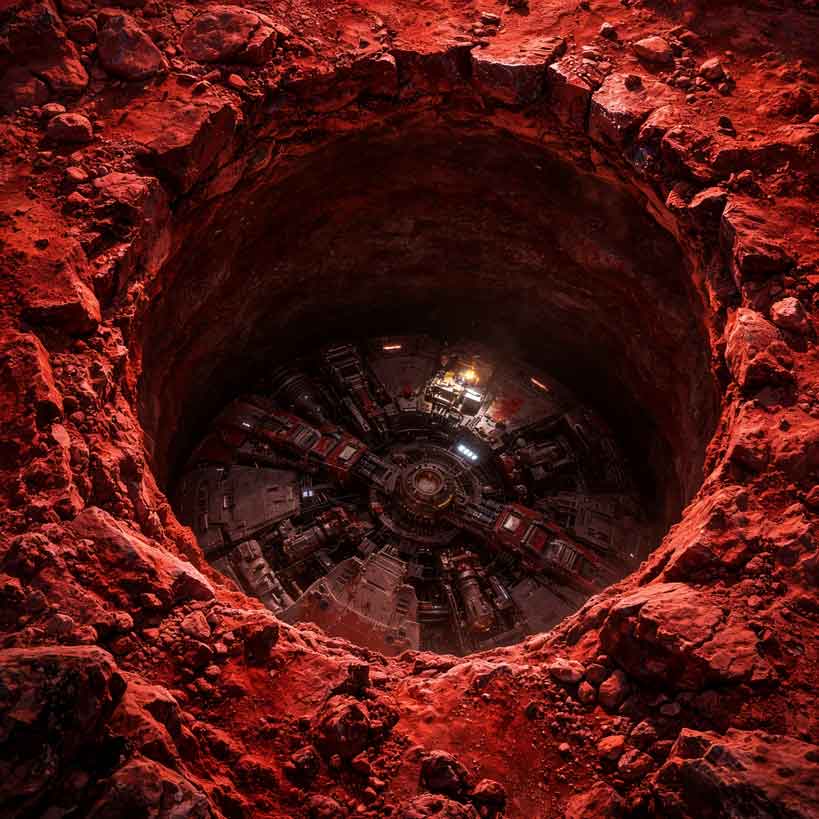
The expedition had begun.
After advancing ten kilometers, they completely lost communication with the base. In hyperbolic space, exponential signal attenuation was no exaggeration.
According to plan, each week they would select a relatively safe region and drill upward to create a temporary vertical shaft reaching the surface. There they conducted astronomical observations to recalibrate position and gathered environmental data. These shafts could also serve as potential shelters or exploration nodes for the base team. Afterward, they cleared debris as thoroughly as possible, sealed the shaft entrance, and resumed their subterranean voyage.
The sole encouraging sign was that the helium-3 signal steadily strengthened as they advanced.
Yet new discoveries brought new uncertainties. The signal was no longer a distinct point source. Instead, it gradually diffused into a considerably broad region—possibly indicating a vast deposit, or perhaps an exceptionally complex geological structure.
Meanwhile, life at the ship base was equally harsh.
With the departure of Chief Engineer Karlovich and the only heavy drilling equipment, their operational capability was severely constrained. Relying on foot travel and light vehicles, they explored a radius of one hundred kilometers around the ship. The results were discouraging. Apart from the meteor crater—already largely mined for metal—the landscape consisted of endless dark-red wasteland and rolling mountain ranges dotted with stone forests. No additional valuable veins or energy sources were found.
One month later, in order to extend the search perimeter, the base team decided to dispatch a squad led by Elena, accompanied by biologist Elisa and the geologist’s assistant Marcus. They would use the first vertical shaft drilled during the expedition’s initial phase—Shaft 001—as a forward staging point, expanding exploration outward from there.
Since no further tunneling was required, they traveled using robots capable of both horizontal driving and vertical wall-climbing ascent. The real difficulty lay in clearing the immense volume of debris.
It took them an entire month to climb out through the wilderness-isolated mouth of Shaft 001.
The effort was worthwhile. If attempted on foot across the surface, the distance from the ship base to this point would have been nearly equivalent to circling half the Earth.
Yet the scenery had not changed.
It was still an immeasurable expanse of red rock.
V. Remained Group Exploration
Using the shaft as a temporary camp, Elena’s team continued outward exploration for another month—still without results.
Just as discouragement began to settle in, they witnessed something utterly different from atop a ridge.
Below lay the remnant of a vast, solidified lava river. Yet its color was not the familiar dark red. Instead, it shimmered with metallic hues—deep blue and ochre gloss. This was entirely unlike the lava flows they had previously seen, those formed when a passing “sun” melted the stone forests.
Excited, they rushed down the slope and followed the ancient riverbed upstream in search of its source. After a long trek, they reached a region not completely remelted—and were stunned by what stood before them.
A “forest” spread across the landscape.
But these were not carbon-based trees. Instead, dense arrays of bizarre silicon-based tubular structures rose vertically from the ground. They ranged from ten to thirty meters tall. Their walls were semi-translucent; within them, one could faintly discern a slowly flowing liquid emitting a dim fluorescence.
Under the violet firmament, these “giant tubes” stood silent and motionless—yet charged with an uncanny vitality.
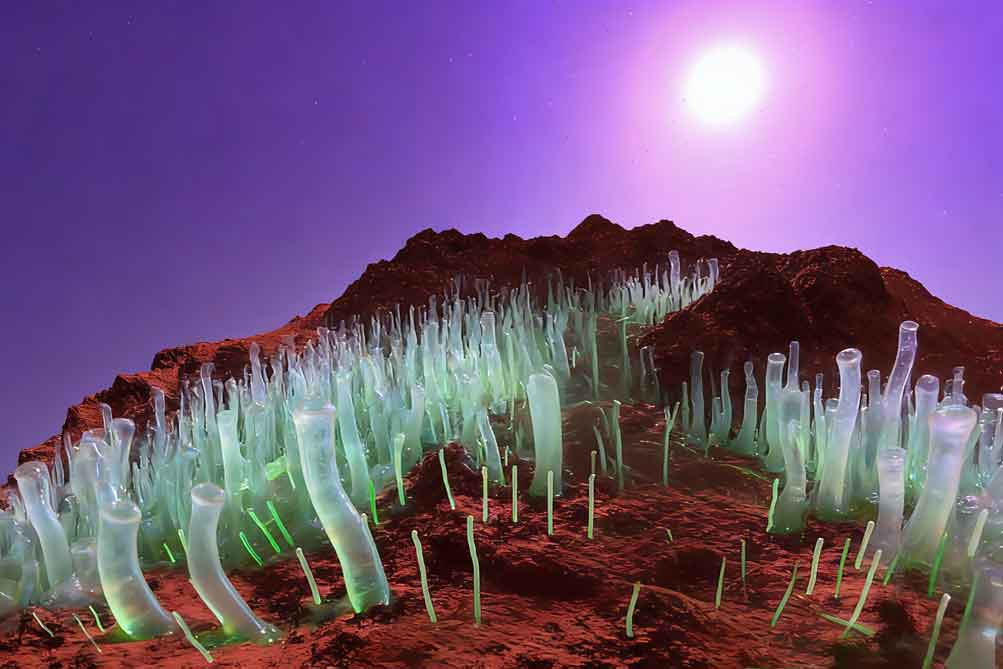
“There are… living things on this planet. They look like plants…” Elisa’s voice trembled with excitement.
Preliminary spectral and atmospheric analyses indicated that during the “day,” when a sun swept nearby, the tubular structures absorbed radiative energy. During the “night,” they emitted faint light—possibly chemical luminescence or extremely inefficient bioluminescence. They also detected slow gas exchange: absorption of carbon dioxide and release of small amounts of oxygen.
Marcus, the geologist’s assistant, focused on the accumulations at the bases of the structures. There lay thick deposits of fine powder composed primarily of silicon dioxide. In other words, these organisms appeared to metabolize both silicon and carbon simultaneously.
Yet none of the expected rare elements were present.
Marcus proposed surveying along the forest’s perimeter. The terrain there was relatively flat; they could travel by vehicle, though the ride was brutally rough.
Once the initial excitement faded, the forest’s scenery became monotonously repetitive. The glowing giant tubes lost their mystique, replaced by strangeness and silence.
On the fifth day of travel, they encountered something new.
Ahead lay an impact crater—an awe-inspiring sight. Over five hundred meters in diameter, its rim bore a glassy sheen. The center still radiated dark red residual heat. Elemental analysis yielded an unexpected discovery: within the ejecta and resolidified condensates, they detected anomalous enrichment of multiple high atomic number rare metals, as well as a previously unseen silicon–carbon–boron composite with a distinctive lattice structure. These materials did not originate from the local red rock. They were evidently carried by a “sun” and synthesized instantaneously under extreme impact conditions.
“This is an entirely new material,” Marcus reported excitedly. “Its strength and thermal resistance may far exceed anything we’ve imagined. If we can stabilize its acquisition or synthesis, it could reinforce drilling machinery—or one day form structural components of an interstellar spacecraft. Its value is incalculable.”
To study both forest and crater more closely, they established a rudimentary outpost at the forest’s edge. Detailed observation revealed that the tubular forest existed in a near-stagnant state of life. Over months of monitoring, they observed almost no growth. The internal fluorescent liquid circulated in extremely long cycles. No other lifeforms were detected. The entire forest felt like a monumental and eerie gallery of silicon sculptures.
Still, compared to the pure desert, the forest edge exhibited slightly smaller temperature fluctuations and trace oxygen production. Psychologically, it felt less barren. The team unanimously agreed it was better suited for a long-term foothold.
Thus the nine-member team officially relocated to the forest-edge outpost, rotating periodically with the three-person crew at the ship base.
Over the next two years—by shipboard time—they worked with astonishing perseverance. They reopened Shafts 003 and 004, excavated during the early phase of the underground long march, and extended optical fiber lines to them, integrating these distant exits into a stable communications network.
A deep survey southeast of Shaft 003 led them to a majestic north–south rift valley. The chasm descended hundreds of meters, nearly comparable to the planet’s curvature radius. Sheer cliffs flanked a broad floor. They traversed the valley bottom for two weeks and discovered new silicon-based plant communities.
These forms differed drastically from the tubular forest. One resembled gigantic ferns composed of layered, translucent silicon crystals. Another was stranger still—twisted spiral shells standing silently in the valley’s shadow where violet sunlight never reached. Their internal fluorescent flows shimmered in richer colors.
The expedition yielded substantial findings. Yet as they prepared to return, a near solar flyby melted, collapsed, and resolidified a long stretch of valley wall and deposits. A jagged, still-glowing lava barrier tens of meters high now blocked their path completely.
They chose to climb toward the rift’s upper rim along the partially cooled lava flow’s edge. After a full day’s struggle, they emerged back onto relatively open surface terrain. Exhausted, they began determining bearings for return when sharp-eyed Elisa noticed something unusual on a nearby flat red rock plain. Dozens of circular holes punctuated the surface. Each hole measured about twenty centimeters in diameter. The walls were extraordinarily smooth—dustless, polished as if by high temperature or precision drilling. They extended straight downward into darkness. Flashlights cast into them were swallowed without reflection.
“This isn’t natural,” Marcus said, kneeling beside one hole. “The smoothness exceeds our machining capability. Uniform diameter. Perfect verticality.”
They resembled human-drilled shafts—yet far smaller, and seemingly crafted with far greater precision. With their route blocked and the canyon unusable, and now confronted with this inexplicable phenomenon, Marcus made a swift decision.
“Record all coordinates and environmental data. We lack the stamina and equipment for deep investigation. Return to the forest outpost, resupply, then come back with specialized micro-probe robots.”
Days later, they returned with a specially designed micro-exploration robot. The probe was spindle-shaped, equipped with retractable high-friction wheels on both sides. Suspended over one of the holes, it extended its wheels against the smooth walls, bracing itself much like a human might press limbs against a shaft.
“Begin descent,” Marcus ordered softly. He gradually released braking pressure. The robot slid downward along the vertical wall under precisely controlled acceleration.
Depth readouts ticked upward: 10 meters. 50. 100. The walls remained bafflingly smooth. Material analysis indicated a highly dense, uniformly processed crystalline form of red rock.
“Two hundred meters.” The tunnel’s straightness exceeded expectations. They dared not allow free fall; in an unknown abyss, unexpected strata shifts or obstacles could spell destruction.
“Five hundred… one thousand…” The steady data became unnerving.
When the readout passed 1,700 meters—their previous technological limit achieved only through arduous iteration—murmurs filled the control room. The robot continued descending. Three thousand meters. At that depth, fusion of inertial navigation and continuous wall scanning revealed a stunning fact: the tunnel was not perfectly vertical. While maintaining extraordinary geodesic straightness, its overall trajectory deviated slightly yet unmistakably—tilting about six degrees south by west relative to vertical.
“Not a shaft… a geodesic chord,” said Zhang Mingyuan quietly, staring at the reconstructed trajectory. “The tunnel isn’t digging downward. It’s following the shortest path through hyperbolic space toward a distant surface point.”
But the cost of exploration mounted. Beyond 3,000 meters, even within this near-perfect conduit, signal attenuation and delay worsened severely. Packet loss spiked. Real-time control became marginal. To ensure retrieval, they ordered the robot to ascend.
The first direct exploration delivered staggering results—and defined the next step: fiber deployment. They attached optical fiber to the returning probe and sent it back down. Knowing the first 3,000 meters were unobstructed, they allowed controlled free descent using a pulley system to regulate speed. The fiber descended like a silent nerve along the smooth wall. Beyond 3,000 meters, they resumed cautious slow lowering.
During operations, a close solar flyby forced interruption. Calculations showed the hole’s location would reach only about 120°C—insufficient to melt fiber or rock. As a precaution, personnel and sensitive equipment retreated one kilometer eastward, perpendicular to the flyby trajectory. The robot continued autonomously. After danger passed, they returned to find everything intact. Eventually, all available fiber was exhausted—14,000 meters in total. The robot rested at an almost incomprehensible depth. Data showed it was not at the bottom of a vertical shaft, but within a deep, inclined geodesic tunnel. At that point, the tunnel formed only about a 32° angle with the horizontal.
“Whoever—or whatever—they are… to excavate along geodesics so effortlessly…” Marcus murmured, awe and frustration mingled in his voice. “If we had known how to follow such chords instead of arcs toward helium-3, we might already have gone home.” The awe deepened into confusion.
The tunnel’s diameter—only twenty centimeters—clearly was not designed for humans. Nor did its direction align with the helium-3 signal source. What were they? On this horosphere planet, there had existed—or still existed—a civilization mastering advanced spatial engineering. Where were they? Why leave such relics? Had they departed, perished, or persisted in some form beyond human perception?
Direct exploration of the mysterious tunnel was suspended due to technical limits. Yet systematic planetary surveys continued. Over the next five years, with remarkable endurance, they located and conducted preliminary surveys around Shafts 001 through 012.
The discoveries were fragmented but diverse. They cataloged more than ten morphologies of silicon-based plants—from colossal spiral towers to wafer-thin luminous lichens. All shared the same silicon-dominant structure and internal fluorescent fluid, as though variations upon a common architectural blueprint.
Mineral prospecting also yielded gains. Across different regions, they identified metallic deposits of varying concentration—providing raw materials for the slow expansion of their footholds on this strange world.
VI. Vigil and Return
The tenth year was quietly marked in the ship base log. According to the original estimates, if all had gone smoothly, the underground Long March team in search of helium-3 should already have reached the target region—perhaps even begun their return. Yet from beneath the abyss, from the far end of that interminable subterranean tunnel, there was only silence. The extreme distance and complex geology had rendered any form of conventional communication impossible. Those who remained at the base could only continue their daily maintenance, limited surface exploration, and intermittent contemplation of the mysterious circular holes, while they waited. Hope, like the distant violet starlight, was faint—but never extinguished.
In the twelfth year, during an otherwise ordinary cycle, the base’s main control computer suddenly captured an extremely weak yet distinctly coded pulse of radio-frequency signal. It did not originate from the surface, but from underground—from the direction of the long-silent main trunk tunnel leading toward Shaft 001. For the first few seconds, the duty officer assumed it was a system error or auditory illusion. But the signal steadily strengthened, and its encoding format was confirmed as the highest-priority emergency communication protocol agreed upon before the expedition had departed.
“Base, base, this is the Path of Hope’ drilling team!” The voice that broke through the channel was hoarse and intermittent, yet unmistakable—laden with unimaginable exhaustion and exhilaration. “We… are back.”
Before the base could respond, ground sensors registered vibrations. In the direction of Shaft 001, the ancient, unchanging red rock plain began to swell and crack with a low thunderous roar. From beneath the surface emerged an enormous steel leviathan, scarred by years of ordeal yet gleaming with a newly modified drill head—like some prehistoric creature returning from the planet’s core.
The drilling team had returned, piloting a machine utterly transformed from the one that had set out: a colossal construct bearing the marks of relentless modification and the integration of unknown technologies.
The expedition members stepped out of the fortress-like drilling vehicle, their faces weathered by a decade’s journey, their eyes ablaze with irrepressible excitement. The expedition leader—engineer Karovich, who had resolutely led the team into darkness ten years earlier—faced the stunned and expectant comrades who gathered around him. He slapped the gray-red rock dust from his suit, dust utterly different from the dark crimson surrounding the base, and said in a voice rough with emotion: “Where should I begin? You may have guessed already—there truly is intelligent life on this planet. And this world is stranger than our wildest imagination. But most importantly—” He drew a deep breath and announced each word deliberately. “We can go home.”
Beneath the warm dome of the base, the drilling team recounted an epic journey far beyond anyone’s expectations. They had indeed spent nearly ten years following the originally planned limit of 1,700 meters of circular depth, enduring immense hardship before finally reaching the region where the helium-3 signal was strongest. Yet hope instantly collapsed into deeper disappointment: there was no concentrated ore vein, no expected helium-3 pocket. Surveys revealed that helium-3 existed only in extremely low abundance, uniformly dispersed throughout the vast gray-red strata beyond, like salt dissolved in an ocean. “We made rough calculations,” said the accompanying geologist Zhang Tian with a bitter smile. “To extract enough helium-3 to fill the ship’s fuel tanks would theoretically require mining and processing trillions of tons of rock. With the drilling and logistical capacity of the Path of Hope,’ that would be like trying to empty the Pacific with a spoon—not to mention we have no means to build a large-scale isotope separation facility.”
In despair, they had done what the surface team had done: wander and explore aimlessly. About a year later, they too discovered the smooth, vertical, unfathomable circular holes. But their discovery went further. In some of the holes, suspended precisely along the central axis, hung a thread so slender it was almost imperceptible—neither metallic nor crystalline. It appeared to make no contact with the walls, simply existing along the core of the shaft, where occasionally an almost vanishingly weak, non-electromagnetic energy pulse would flicker through.
While they were cautiously studying these threads, “they” arrived. There had been no warning, no sound. From a nearby circular hole slid several beings roughly half a meter tall, vaguely resembling upright crustaceans, their shells bearing gray-white striations like stone. Their movement was fluid, utterly vibrationless. Their physiology was complex; it was impossible to distinguish eyes or mouths. Their shape defied easy description, yet conveyed a quiet, lucid intelligence. The initial contact was tense, but both sides possessed self-interpreting communication systems built upon fundamental physics, mathematics, and logic—a standard precaution for interstellar civilizations.
The communication barrier dissolved rapidly. The humans observed that these beings also lacked vocal organs. Rather than ask what they should be called, the captain proposed simply naming them the Horoan—inhabitants of the horosphere world. The Horoan appeared to possess organs capable of directly emitting radio waves. Through interpretation, they explained that the circular holes were nodes of their deep communication tunnel network, and the central threads were cords used to transmit information and minute amounts of energy. The human team’s probing disturbances of the cords had triggered automatic monitoring in the network, leading them to investigate.
The Horo’s friendliness surpassed all expectations. Once they understood humanity’s predicament and purpose, they demonstrated astonishing engineering capability and efficiency. To enable the massive drilling vehicle to enter their tunnel network, they quickly returned to a nearby node and retrieved peculiar tools. In only three hours, using devices that emitted gentle oscillations capable of efficiently loosening rock, combined with high-strength composite materials, they carried out near-inconceivable modifications to the forward structure of the Path of Hope.” They not only reinforced its structural integrity but also installed interfaces compatible with Horoan tunnel navigation.
Guided by a Horoan navigator, the modified drilling vehicle followed a specific geodesic tunnel, descending at speeds far beyond humanity’s previous limits, directly confronting exponentially increasing pressure. Ultimately, they penetrated approximately eighty thousand meters of strata and entered a subterranean cavity that defied belief. It was a bustling underground city. Countless tunnels of varying thickness and orientation converged here, forming a complex three-dimensional hub. Compact Horoan individuals piloted streamlined vehicles, darting through the tunnels at high speed in orderly fashion. Yet the Horoan informed them: “This is not our principal residential zone. The geometric properties of hyperbolic space grant the subterranean geodesic tunnel network unparalleled advantages in transportation and trade. This city is essentially a commercial and transit center that evolved naturally from a major transportation node. Most of our population still lives on the surface, but our crucial activities and economic lifelines are hidden here.”
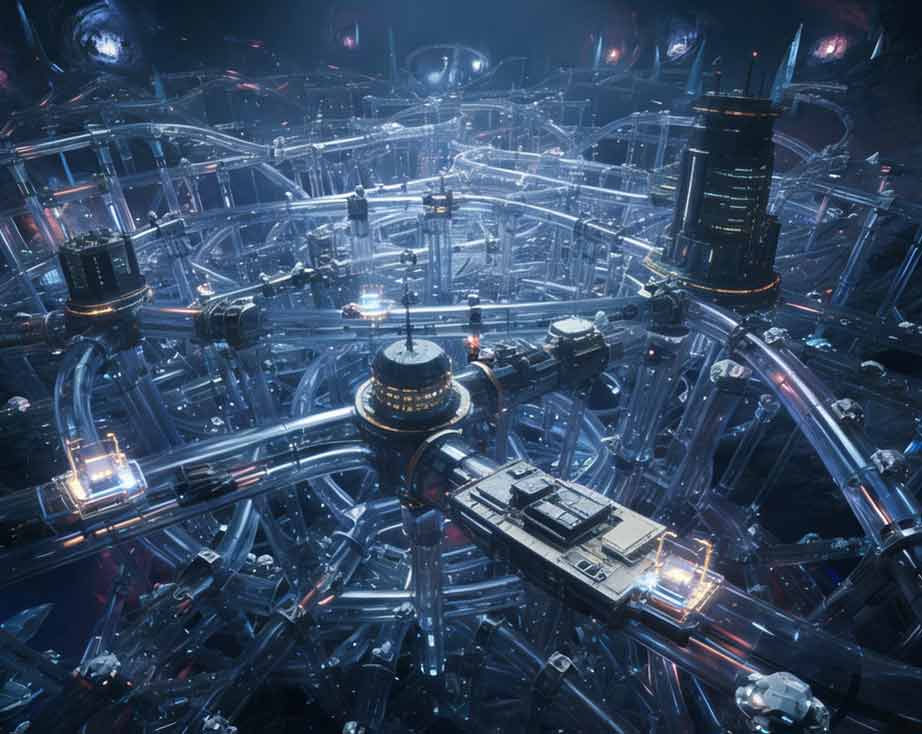
The Horoan further elaborated on the essential point: “From here, by following different geodesic tunnels, one can travel in near-straight lines to extremely distant points on the planetary surface. Owing to the shortcut effect of hyperbolic geometry, the effective coverage of our tunnel network—if projected into the Euclidean spatial concepts familiar to you—would possess a radius exceeding that of the observable universe.”
Regarding helium-3, the Horoan offered a simple solution: there was no need to mine and refine it independently. Within their vast underground economic system, helium-3 was already a high-value energy commodity available in purified form for trade. In exchange, humanity provided information about hyperbolic-space wormholes, along with the coordinates of Earth’s universe and an overview of its civilization. The humans learned that the existence of large-scale flat space had long been a matter of intense debate within Horoan scientific circles. The information humanity had carried through the wormhole enabled this extraordinary exchange across space and time.
VII. Invited Deep Tour
After acquiring the fuel, the Horoan explained that by using their high-speed subterranean tunnel network, the return to the ship base would take less than half an hour. However, the Horo’s highest administrative node—the National Coordination Nexus—having learned of the extraterrestrial visitors, issued a formal invitation. They hoped the humans would spend three days gaining a deeper understanding of Horoan civilization.
Due to size constraints, humans could not enter the standard passenger tunnels. The Horoan arranged for them to travel aboard oversized freight carriers operating in the lower strata of the city, thus beginning a journey into the depths of the subterranean realm. They soon realized that the city they had first reached was merely a minor node within an immense underground network.
Their vehicle sped along a main trunk tunnel, merging at intervals into ever larger hub cities. These cities increased layer by layer in scale, expanding their complexity and grandeur like a fractal structure. In total, they passed through twenty-three progressively larger urban nodes before arriving at the entrance to a deep trunk tunnel on that route. The carrier then turned into this passage, passing through another twenty-three nodes that gradually decreased in size—though each remained vast—before finally emerging from an enormous surface exit into what the Horoan described as the nearest “super-giant surface city.” If one were to traverse this distance in a straight line across the surface, the span would amount to an astronomical figure exceeding the scale of the human observable universe; yet within the Horo’s high-speed tunnel network, the journey had taken only three hours.
“As you can see,” explained a Horoan scholar assigned to receive them through the translation system, gesturing toward the seemingly barren yet secretly intricate planet beneath their feet, “our world’s surface resources are distributed with extreme unevenness and scarcity. Fortunately, within hyperbolic geometry, once we master efficient transportation along geodesics, we can always locate suitable resource points scattered at unimaginably distant separations—though by surface distance alone, those separations would appear hopeless.”
At the center of this colossal surface city stood a staggering construction: a giant storage structure roughly one kilometer in diameter and of comparable height. It was not a simple cylinder. “On a horosphere planet,” the Horoan scholar said, indicating the structure, “vertical lines directed downward converge exponentially due to geometric effects, while those directed upward diverge exponentially. Therefore, the primary data storage volume of this facility is concentrated in its upper portion. This design allows us to store quantities of data beyond your imagination—not merely ‘vast,’ but hyperfinite information exceeding the limits of conventional mathematical description, belonging to hyperbolic space itself. Within this structure are stored maps of the partially traversable geodesic network we have explored so far. Even this portion alone contains more information than the total data content of your observable universe.”
They further learned that Horoan civilization’s political structure was deeply rooted in its unique spatial geometry. Across the explored regions of the planet, it was estimated that more than 10¹³⁴ political entities or states existed. The size of a state was not measured by traditional surface area, but by the hierarchical depth and hub complexity of the subterranean transportation network it controlled—specifically, the depth of underground nodes one must traverse to cross the polity. Approximately ninety percent of governmental core functions were located at key subterranean hub nodes.
The political entity hosting the human delegation possessed a node depth of 6,832 layers—a large state by Horoan standards. This meant that from the most basic local community to the highest central authority, there existed more than six thousand administrative or governance levels. Surface administrative divisions mirrored similarly intricate nested hierarchies.
“Occupying deep, efficient transport corridors and hub-city space is extraordinarily costly,” the Horoan scholar admitted. “Because all individuals and resources seek to utilize these shortcuts, congestion is an eternal issue. The cost is not technological—it is opportunity cost. One occupies the most valuable and scarce public resource within the entire civilization’s system. Upon learning of your presence, our twenty-sixth-tier political leader authorized a ‘green channel.’ Otherwise, the toll for your journey would have been an astronomical figure.”
“Yet such advanced transportation has not resulted in extreme centralization. Our governance adheres to the Principle of Three-Tier Jurisdictional Limit,” the scholar continued, outlining their political philosophy. “For any local surface matter, higher administrative bodies rarely intervene beyond three hierarchical levels. Beyond that, although the straight-line distance within the subterranean network may not be great, the divergence in surface position and social ties becomes so vast that information distortion and governance cost exceed benefit. The core role of state authority lies primarily in ensuring fair access to the underground transport network, establishing standards, constructing major hubs, and responding to the rare crises capable of destabilizing the entire network. Most of the time, node cities and communities enjoy a high degree of autonomy.”
“Next, we will show you how we manage this infinite world.” The Horoan scholar guided them to a massive circular control console. A dynamic electronic map was projected into the air, freely scalable. “This is our surface-layer map, recording only surface information; subterranean nodes and tunnel networks are temporarily hidden.”
With a gesture, the display shifted instantly into hierarchical mode. “The political entity in which we stand contains 6,832 node layers. To display it fully on a traditional planar map, you would need to zoom out more than six thousand consecutive times, each step confronting exponentially changing quantities of information. Simply completing a transition from a small village at one edge of the state—zooming out to encompass the entire territory, then zooming in to another small village on the opposite side—could require nearly an hour, almost equivalent to riding a high-speed carrier through several major nodes.”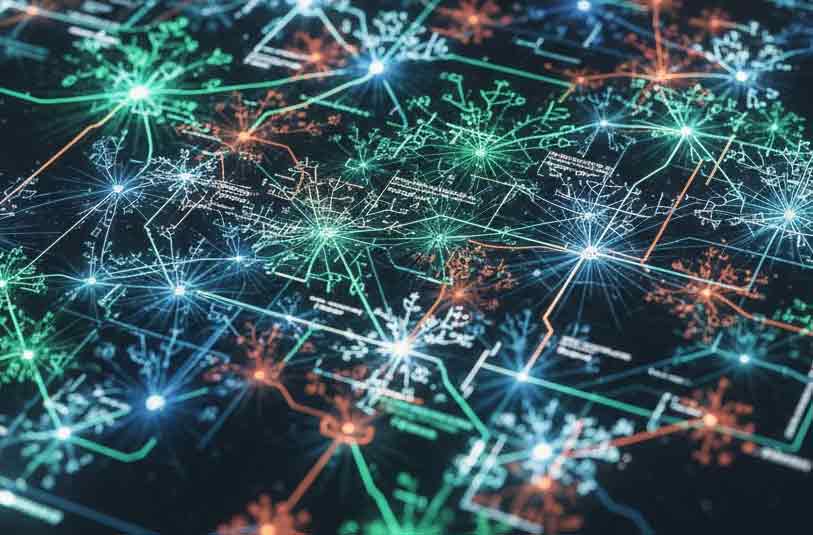
The interface transformed again into a highly abstract visualization composed of nested tree-like nodes and radial connections. The Horo’s everyday mapping system was essentially a compressed view achieved through two successive logarithmic transformations of hierarchical structure. It sacrificed intuitive spatial relationships, yet enabled efficient indexing, localization, and management of any surface or subterranean point’s associated administrative tier, resource allocation, and transit permissions. Without such data compression and intelligent navigation algorithms, even the act of viewing a map in this world would become a prolonged virtual expedition.
They then boarded a high-speed freight carrier and toured several neighboring regions surrounding the super-giant city with unprecedented efficiency. “Neighboring,” in this context, referred to straight-line travel along optimized geodesic tunnels requiring no more than half an hour. Yet their Horoan guide informed them that the average surface straight-line distance between these stations, measured on the scale of the human Solar System, was roughly equivalent to the span from Earth to the orbit of the Kuiper Belt.
During this brief journey, they witnessed astonishingly diverse landscapes: boundless polar tundra covered in fluorescent blue-white moss; vast oceans surging with unknown viscous liquids; green-rock plateaus studded with emerald-like crystalline formations utterly unlike their original landing site; and brown-rock mountain ranges streaked with rust and ochre, rich in metallic veins.
“The red-rock region where you first landed and the gray-rock region you later drilled through are merely two negligible points lying close together on this planet’s surface skin,” the Horoan scholar explained. “Each independent geomorphic sector you see possesses a surface area nearly exceeding the entire photosphere of your Sun; some are even larger than the spherical region enclosed by the outer boundary of your Solar System’s Kuiper Belt. With your previous method of slow cruising at fixed depth, a single finite-lifespan member of your civilization might spend an entire lifetime without fully exploring even two such geological sectors.” He paused, then offered a statistic that sent a chill down the humans’ spines: “In fact, had you not encountered us, and had you continued along your original path and speed, reaching the nearest commercially viable helium-3 enriched vein in the brown-rock region would have required… nearly eleven hundred more years of drilling.”
Regarding the distribution of solar activity, the Horoan provided precise statistics based on prolonged observation. “Different regions receive vastly different illumination and thermal disturbances. Approximately two percent of the surface area is almost never visited by a sun—absolute perpetual night, with temperatures remaining around minus 140 degrees Celsius. The overwhelming majority, about ninety-five percent, experiences chaotic and irregular solar flyby events. The environment where you first landed belongs to this category, filled with random risk.”
“In addition, less than one percent of regions endure frequent solar impacts or extremely close flybys, rendering them exceptionally hostile. The remaining roughly three percent,” the Horoan scholar added, his tone carrying a warmth reminiscent of homeland, “possess relatively stable, predictable quasi-periodic solar trajectories. ‘Periodic’ does not mean that any single sun follows a cycle, but rather that different suns pass across the sky in orderly succession. These regions provide comparatively moderate energy input and thermal stability. Our distant silicon-based ancestors, and the early Horoan civilization that later evolved, originated precisely within these precious stable zones.”
VIII. Horoan Civilization
The humans then raised the most crucial question: how had such a vast network of tunnels and cities been constructed?
The Horoan scholar offered a number that completely destabilized the human sense of time: “The age of our hyperbolic universe is estimated at approximately $10^{40}$ years. Our civilization has evolved continuously for about $10^{15}$ years. Around ten billion years ago, our ancestors achieved breakthroughs in materials science and spatial geometric dynamics, mastering truly ultra–high-speed directed geodesic drilling technology.”
“It was this core technology,” he said, gesturing toward the omnipresent tunnel network beneath their feet, “that enabled us to carve these passages along optimal spatial paths at acceptable cost and efficiency. Its emergence not only transformed transportation and resource acquisition, but directly gave rise to the prototype of political and social structures based on node control and hierarchical management. One might say that the entirety of our present civilizational form rests upon this super–ultra–high-pressure-resistant void-stabilization technology born ten billion years ago.”
Their culture thus displayed a pronounced nodal character and path dependence. Individual identity was closely tied to the node cities one frequented, the segments of tunnel network one understood, and the transit permissions one possessed. Art often expressed geometric beauty and the philosophy of journeys; literary epics recounted the exploration of new biomes or the construction of major hubs. Because surface distance was distorted by tunnels, the concepts of “far” and “near” became elastic and subjective, and social networks consequently exhibited dynamic, multidimensional characteristics far exceeding the complexity of human societies.
In discussing social structure, the Horoan shared two representative conflicts that revealed the intricate tensions within their world.
The first occurred roughly two hundred years ago in a micro-state possessing only thirty-four node layers. In this rigidly stratified hierarchy, proximity to the upper surface layers corresponded to more basic, densely populated civilian regions, while deeper lower layers corresponded to higher administrative and resource-control centers. The management institutions at layer thirty and below unilaterally imposed steep increases on tolls at critical transit nodes and residency taxes in core cities. In a Horoan world where resource distribution was already highly uneven, grassroots populations depended heavily on goods transported through the node network; soaring prices rendered life unbearable. Some desperate individuals attempted migration or even begging through extraordinarily long shallow tunnels or perilous, near-hopeless surface journeys.
Resistance eventually erupted. The first revolution failed swiftly—for in a hyperbolic-geometry state, a bottom-up assault was nearly hopeless. The surface base covered immense area, making it difficult to concentrate rebel forces; tunnel entrances leading downward were few and easily defended, and the deep regime needed only to seal key nodes to strangle the offensive.
In the second attempt, however, the revolutionaries adopted a radically indirect strategy. The small country had five neighbors, two of which were major states possessing over one hundred node layers. The revolutionaries carefully cultivated a cadre of spies, not for direct assault but for passage. Because cross-border subterranean tunnels were equipped with strict customs controls directly linked to deep central hubs, large-scale military mobilization could not be concealed. Thus began an epic clandestine migration: the most resolute rebels first used their own national tunnels to reach the boundary circular aperture closest to the target neighbor, then traversed the surface into foreign territory. The border region lay within a vast perpetual-night zone, with extreme climate and immense distances. This overland march across natural abyssal barriers lasted the equivalent of forty human years. The deep regime had never imagined that grassroots citizens could overcome such geographic chasms through sheer endurance.
With assistance from spies long embedded within the neighboring state, the expeditionary force entered the neighbor’s network through its circular aperture and descended to layer thirty-five—positioned directly beneath their own homeland’s governmental core at layer thirty-four. They infiltrated and assembled silently, then launched a lightning vertical strike, sealing all upward and downward passages of the city housing their homeland’s government and deploying specialized toxic gas weapons, thereby ending the regime.
“There are many details,” the Horoan scholar concluded. “The layer-spacing distribution within the neighboring state differed greatly; its hierarchy was somewhat irregular and did not correspond neatly with that of the small country. The infiltration, persuasion, and eventual tacit approval, or even bribery of certain nodes within the neighboring society could itself fill a voluminous epic. In our world, surface distance can be both a defensive abyss and a corridor for surprise assault.”
The second conflict occurred between two great powers, sparked by competition for control of a newly discovered rare resource vein. War first erupted at the shallowest customs-connection hub of the two underground networks and rapidly spread along connected tunnels to upper and lower nodes and their corresponding surface regions. Yet within the tunnel network, offensive advantage was extremely limited; the ease of defense quickly turned the conflict into an exhausting stalemate. Only after one nation secured decisive superiority on the surface battlefield—seizing control of the opponent’s border surface region and then purging and occupying, from top to bottom, all node cities extending downward from that region—was the balance broken. The other nation soon redeployed surface forces from other directions and counterattacked. Ultimately, after immense expenditure, both sides returned to negotiations, ending in a draw.
Their Horoan guide added that some Horoan doubted whether their planet was truly infinite, suggesting instead that its radius might merely be extraordinarily large. With near-magical drilling and tunnel-maintenance technologies, certain vacuum glide tunnels constructed from specialized materials allowed vehicles to accelerate with almost no resistance. In the Horoan universe, the time axis was flat, and space itself possessed an absolute rest background reference frame. When a craft’s velocity became too great, severe lateral tidal stretching effects arose—not from gravitational gradients, but from the intrinsic geometry of hyperbolic space. These geometric tidal forces imposed an upper limit on skeletal stress tolerance, thereby restricting the maximum permissible speed for exploration of the horosphere planet. The deepest geocentric research vessel had already traveled vertically downward along a geodesic length approaching the diameter of the Solar System, yet no evidence whatsoever had been found that the radius was finite. If finite, it would likely span at least light-years.
Their observed cosmic panorama likewise displayed unique structure due to geometric effects. Besides the “suns” that swept quasi-periodically along geodesics, most celestial bodies were similarly moving stars or planets. Generally, faster-moving bodies possessed smaller radii, while slower-moving ones had larger radii. A small fraction were horosphere planets akin to their homeworld—fixed at infinity, with theoretically infinite radii, like immense bubbles suspended within the hyperbolic abyss. The Horoan database recorded over one million suspected large-radius horosphere planets, about half classified as stars. The vast majority of the solid ones were extremely barren, lacking stable solar activity, shrouded in perpetual night, with temperatures approaching absolute zero, incapable of sustaining life.
Despite its long and glorious technological history, Horoan civilization had not developed advanced space exploration. This had profound geometric roots. Once freed from gravity into interplanetary space, a spacecraft entered fully isotropic three-dimensional hyperbolic space. Unlike the surface of a limit sphere, where an Euclidean metric allowed straightforward latitude–longitude navigation, deep space offered no intuitive reference for “all directions.” Movement in any direction encountered exponential metric expansion; navigation was extraordinarily difficult, even the recording of coordinates posed formidable challenges, and mortality rates were discouragingly high. More critically, space travel did not serve as a shortcut to surface transport. On the contrary, hyperbolic exponential effects were even stronger in space: regardless of how far one traveled in any direction, if one returned to the originating horosphere planet, the landing region would inevitably lie near the departure point. Space travel offered no extension of accessible surface range. Thus, apart from a handful of fixed routes, few Horoan ventured into space exploration beyond the pursuits of a small number of cosmologists driven by theoretical curiosity.
As for those fixed routes, they were geodesic trajectories leading to certain suspected horosphere planets of resource-development value. The ground starting points of these routes had evolved into super-giant cities. Over hundreds of millions of years, the Horoan had detected only several tens of thousands of exoplanets possessing stable periodic micro-suns capable of supporting ecosystems. Of these, fewer than three hundred were at moderate distances warranting investment for development and migration. Yet even these three hundred were not easily reached. Generations of Horoan pioneers had paid with countless lives to explore and record fixed routes to them. These routes were navigated by “fingerprint-level” stellar cartography and recorded through layered node documentation, the only means of overcoming the numerical precision challenges posed by exponential spatial expansion. But the routes were extremely fragile: any deviation from navigation, without exact retracing, would result in exponential divergence from the destination, leaving the vessel irretrievably lost in endlessly extending hyperbolic space, where exponential signal attenuation extinguished all possibility of rescue.
Another deep physical constraint limited Horoan interstellar exploration: beyond a certain velocity threshold, a spacecraft would be torn apart internally by pure hyperbolic geometric tidal forces, as though ripped by invisible hands. Thus, spacecraft velocity in their universe was strictly capped; any rash maneuver risked catastrophic destruction. This further confined their range—what humanity could accomplish in a week’s journey to Mars might require years in the Horoan universe.
As for wormholes, in the $10^{15}$-year span of Horoan civilization, only tens of thousands of recorded wormhole events existed—extremely rare on such a timescale, averaging once every hundred million years even after observational technology matured. This did not imply wormholes were intrinsically rare in the hyperbolic universe, but many likely appeared near planets without nearby instruments to record them. About half were inferred only through remote gravitational-wave detection or background radiation disturbances; their relative motion near the horosphere surface approached light speed, permitting no practical contact. A little over a hundred were observed at close range, allowing probes or crewed vessels to traverse their throats into unknown realms. Very few returned—barely more than a dozen successful returns. Of those, about half led to other negatively curved hyperbolic universes with similar curvature values, forming apparent corridors between like universes. Five cases were even more astonishing: the opposing universes possessed curvature ratios ranging from 0.2 to 8 times that of the Horoan’s universe.
The most extreme encounter involved a positively curved spherical universe. Data transmitted by probes indicated a finite, self-closed three-dimensional spherical world. However, the wormhole connection proved unstable. After merely two circuits within the throat, collapse began. In the final signal received, that finite spherical universe was expelled from the wormhole and merged into the Horoan hyperbolic space like a cell undergoing exocytosis—a violent spacetime fluctuation event. The released gravitational waves instantly destroyed the probe, yet even their power succumbed to exponential attenuation. At Horoan observatories, only a faint tidal wail was recorded before the signal vanished forever.
Horoan cosmologists emphasized that all these detected constant-curvature spacetimes—whether hyperbolic or spherical—involved curvature of space alone; the temporal dimension remained flat. Thus, they did not satisfy the Einstein field equations as humans understood them. The Horoan regarded such spacetime as natural, and throughout their history had never encountered a true Einsteinian spacetime—one in which both space and time curved together, as in de Sitter or anti–de Sitter universes predicted by general relativity. The intersection of those two models was flat spacetime. Intriguingly, they had never observed precisely the flat spacetime inhabited by humanity.
Various explanations had been proposed by Horoan theoretical physicists: perhaps flat spacetime could not stably exist in any observable universe and would acquire curvature under perturbation; perhaps a topological barrier prevented connection between flat and hyperbolic spaces; perhaps flat spacetime was too fragile to form stable wormhole conduits. Yet these remained conjectures. Without humanity’s arrival, they might never have realized that beyond a wormhole lay a geometrically near-flat universe supporting complex life.
It was worth reflection that because of the fundamentally infinite nature of the Horoan planet, they could never dynamically scan every inch of its surface. Wormholes appeared and vanished swiftly, and their celebrated subterranean geodesic network covered only finite nodes, incapable of monitoring the entire surface. Thus, when the wormhole to the human universe briefly opened above the red-rock region, it lay entirely outside the field of view of any routine Horoan monitoring system.
“Had humanity not arrived,” one Horoan scholar admitted candidly, “we would have missed this opportunity entirely. You not only found us—you made us realize that within an infinite universe, some connections that lie within arm’s reach require the other side to extend a hand first.”
Three days of visitation were brief yet overwhelming in information. With tanks filled with helium-3, small samples of deep geocentric rock and soil gifted by the Horoan, and a preliminary inter-civilizational contact protocol established, the humans reboarded the modified drilling vehicle and began boring along the optimal homebound geodesic calculated by the Horo—direct toward the ship base.
IX. The Final Return
Half an hour later, the drilling vehicle broke through the surface near the ship base with precision, raising a cloud of gray-red dust. After twelve years, the expedition team and the stay-behind team were reunited. They embraced warmly; after recounting their extraordinary experiences, it was time for the final sprint home.
“Activate main engine. Maintain minimum power output. Lock altitude—fifty meters above surface.”
Under Horoan guidance, they launched the massive Endeavour. With a low hum, the vessel rose slowly, then shifted into near-surface hover flight. Its speed was carefully increased to just below the tidal stress warning threshold to ensure safety. The ship’s size prevented entry into the drilled tunnels, yet even such low-altitude flight, under hyperbolic metric compression, drastically shortened the effective distance to the wormhole coordinates compared to their high-altitude approach twelve years earlier. The vessel skimmed across red and gray wastelands; lonely silicon forests and impact craters receded behind them, the sensation of speed rendered uncanny by warped spatial optics. Soon they arrived beneath the wormhole and held position.
At parting, the Horoan presented them with a gift: a hyperbolic regular dodecahedral core bound by strong interaction forces, stable only within a negatively curved background.
“When you return to flat space, it will gradually disintegrate as it loses geometric angular constraint support,” the Horoan explained. “We predict the process will release a distinctive gravitational-wave spectrum. It is a rare experimental opportunity. Should you one day detect such geometric decay signals in your cosmos, it may indicate proximity to an unnoticed spacetime interface leading to a world like ours.”
The Endeavour ascended. With increased thrust, it accelerated along a trajectory that curved subtly rather than shooting straight upward. Looking back, they watched the pale violet planet shrink exponentially until it vanished like a star. It was no longer merely a barren prison, but a living, boundless civilization shaped by geometric law.
They reached the wormhole entrance—a mercury-like vortex suspended in the void, still near its original coordinates, drifting no more than a kilometer. Helen inhaled deeply and uploaded the final navigation packet containing instantaneous geometric parameters transmitted by the Horoan. The ship adjusted orientation, aligning with the fragile throat connecting two universes.
Curvature readings reversed their previous pattern: first decreasing to more negative values, then slowly rising. All eyes fixed upon the display, waiting for the curvature to return to zero.
Home had never seemed so clear—nor the word “universe” so profound and complex.
The moment arrived.
At the instant of transit, almost everyone felt an inexplicable sense of release. Some of it may have been the disappearance of geometric tidal stress; more of it was psychological contrast after prolonged adaptation to non-Euclidean visual reference frames. On the main display, starlight resumed familiar straight trajectories; all hyperbolic compression and distortion vanished instantly.
Zhang Mingyuan removed the hyperbolic dodecahedral core. In flat space, it immediately blurred, its edges dissolving like ink in water. Within his specially modified curvature detector, it emitted concentric, perfectly structured gravitational wave ripples—the fading geometric imprint of negative curvature in a flat universe.
“Captain,” Helen’s voice came through. “Earth Control has transmitted a welcome message. They’re asking what we discovered.”
Elena gazed at the receding wormhole on the screen—the portal to another physical reality.
“Tell them we discovered another possibility of space,” she said, “and that the structure of the universe is deeper and more supple than we ever imagined.” The discoveries of negative curvature space, geodesic optimization, Horoan civilization, and subterranean urban hierarchies would soon transform human physics and cosmology.
The Endeavour accelerated toward the Solar System. Behind them, the hyperbolic geometric core fully evaporated, leaving a faint spacetime ripple detectable only by the most sensitive instruments—a farewell written in mathematics.
And on the horosphere known as Horoearth, their chief scientist adjusted his observatory instruments. On the screen, the light-point representing the Endeavour followed a trajectory that, to the Horoan, terminated at the wormhole, heading toward the mythic, flat, open universe of humanity.
(End)
/// Note: Portions of the plot and descriptive detail in this work were generated with assistance from DeepSeek AI. Illustrations were produced using a horosphere ray-tracing demo in combination with multiple AI tools. This was written in Chinese and translated in English by AI.